

EMI or Full Payment? What's the Smarter Way to Buy a Bike This Diwali?
 Published at November 9, 2026By Saurav Suman
 Prefer Us on
Google News
Buying a new motorcycle or scooter this Diwali 2026 isn’t just about showroom prices and festive discounts. You also have to decide whether to pay the full on road price or finance it through monthly installments.
That choice hits your savings, your monthly expenses and the total you hand over. Paying upfront means no loan interest. EMI keeps cash free for other needs. But a low instalment doesn’t make a purchase affordable. Compare the total borrowing cost before you sign anything.
Bike EMI vs Full Payment: Understanding the Difference
Full payment means you buy the motorcycle or scooter from your savings. No borrowing. You pay the dealer’s complete on road price, including registration fees, insurance and other charges.
No monthly loan. No interest. No processing fee, and no repayment deadlines to track.
But it eats into your savings. That matters if you have other responsibilities, upcoming expenses or a thin emergency fund.
EMI works differently. You pay a down payment and borrow the rest from a bank or finance company. The lender charges interest on the borrowed amount. You then repay principal and interest in fixed monthly instalments over an agreed period.
Take State Bank of India (SBI). It runs a dedicated two wheeler loan scheme with a loan to value limit of 85% of the on road price. So eligible customers can finance up to 85% of the on road cost. The rest comes from your own funds, subject to loan approval and eligibility conditions.
Neither route suits everyone. It comes down to savings, income stability, borrowing costs and what you already owe each month. My take: if you can’t name your fixed monthly outgoings off the top of your head, you’re not ready to choose.
Bike EMI Calculation: How Much Will You Actually Pay?
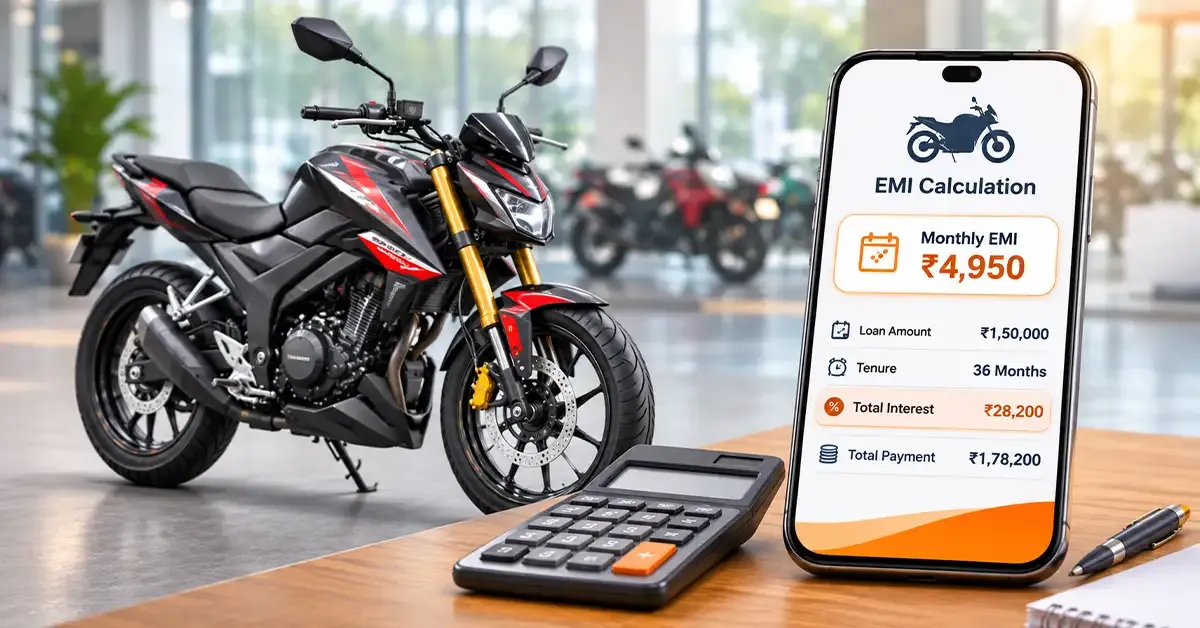
Understand the EMI maths before you pick a loan. Every EMI has two parts, the principal and the interest the lender charges.
Interest rate, loan amount and tenure set the monthly instalment. A longer tenure usually shrinks the EMI. It also pushes up the total interest.
SBI’s two wheeler loan rates currently run from 11.85% to 15.85% a year. The bank last updated this on October 15, 2026. Your actual rate depends on your credit profile and the lender’s conditions. Other banks and finance companies will quote different rates.
Here’s an illustrative loan of Rs. 1 lakh at 12% annual interest, worked out on a reducing balance.
| Repayment Tenure | Approx. Monthly EMI | Total Interest |
| 12 months | Rs. 8,885 | Rs. 6,619 |
| 24 months | Rs. 4,707 | Rs. 12,976 |
| 36 months | Rs. 3,321 | Rs. 19,572 |
| 48 months | Rs. 2,633 | Rs. 26,402 |
These are illustrative figures, rounded to the nearest rupee. They leave out processing fees, GST and other charges.
Look at the gap. The 48 month loan has a much lower instalment than the 12 month one. But it costs about Rs. 26,402 in interest. The 12 month loan costs about Rs. 6,619.
I’d pick the shortest tenure you can carry without sweating. Don’t choose a loan because the EMI looks friendly. Work out the total repayment first.
Bike Loan Repayment Tenure and Processing Fees
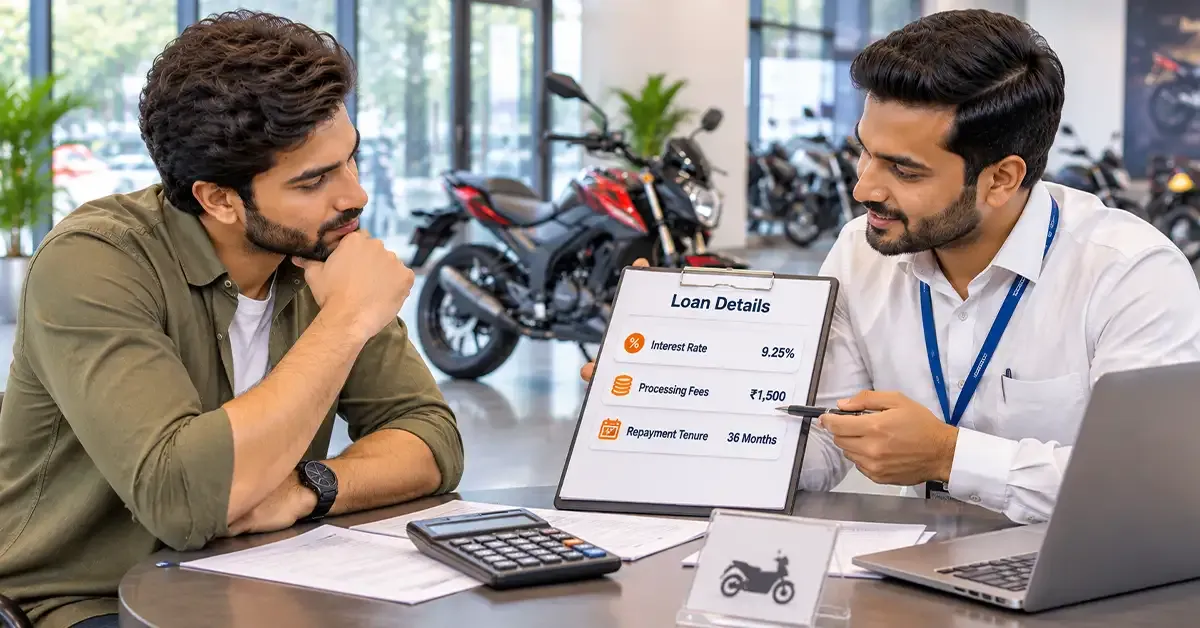
Tenure is the other big lever. Lenders run different repayment periods under different schemes. SBI’s two wheeler loan allows up to 60 months, though your approved tenure depends on the lender’s conditions and your eligibility.
A shorter tenure clears the debt sooner and cuts the interest bill. The EMI is higher, of course. A longer tenure gives your monthly budget more room. But you stay tied to repayments for years.
Then there are the fees. Processing charges push up the real cost of the loan. Some lenders take a percentage of the loan amount, others a fixed fee. GST can apply on top.
Check these costs before you accept any offer:
- Processing fees and applicable GST.
- Documentation and administrative charges.
- Foreclosure or prepayment charges, where applicable.
- Late payment and penal charges.
- Any compulsory third party service charges.
The Reserve Bank of India (RBI) now requires regulated lenders to give a Key Facts Statement (KFS). It lays out the important loan terms before you accept.
The KFS covers the Annual Percentage Rate (APR), the repayment schedule and applicable charges. APR is the yearly borrowing cost, including interest and associated charges. Lenders must also disclose third party charges separately. And a charge missing from the KFS can’t be imposed without your explicit consent.
So ask for the KFS before you say yes to a festive finance offer. Compare APR, not the advertised interest rate. Blunt view: the advertised rate is the bait.
Which Bikes Can Buyers Consider This Diwali?
Pick the bike first. Then compare finance. Your payment decision depends on the motorcycle’s price and how you’ll use it.
Here are three popular commuters and their published prices.
| Motorcycle | Starting Price |
| Hero Splendor Plus | Rs. 78,912 (ex showroom) |
| Honda Shine 125 | Rs. 83,442 (ex showroom) |
| Bajaj Pulsar N125 | Rs. 92,270 (ex showroom) |
Prices come from published manufacturer information. They can vary by location, variant and later revisions.
The Hero Splendor Plus is the practical commuter. The Honda Shine 125 is another pick in the 125cc commuter segment. The Bajaj Pulsar N125 is for buyers who want something sportier. These are different choices, not a head to head on finance deals.
My take: the Splendor Plus at Rs. 78,912 is the easiest one to justify paying for in full.
Get the final on road quote from your local dealer. Registration, insurance, accessories and taxes will change the amount you pay.
EMI or Full Payment: Which is Better for Your Budget?
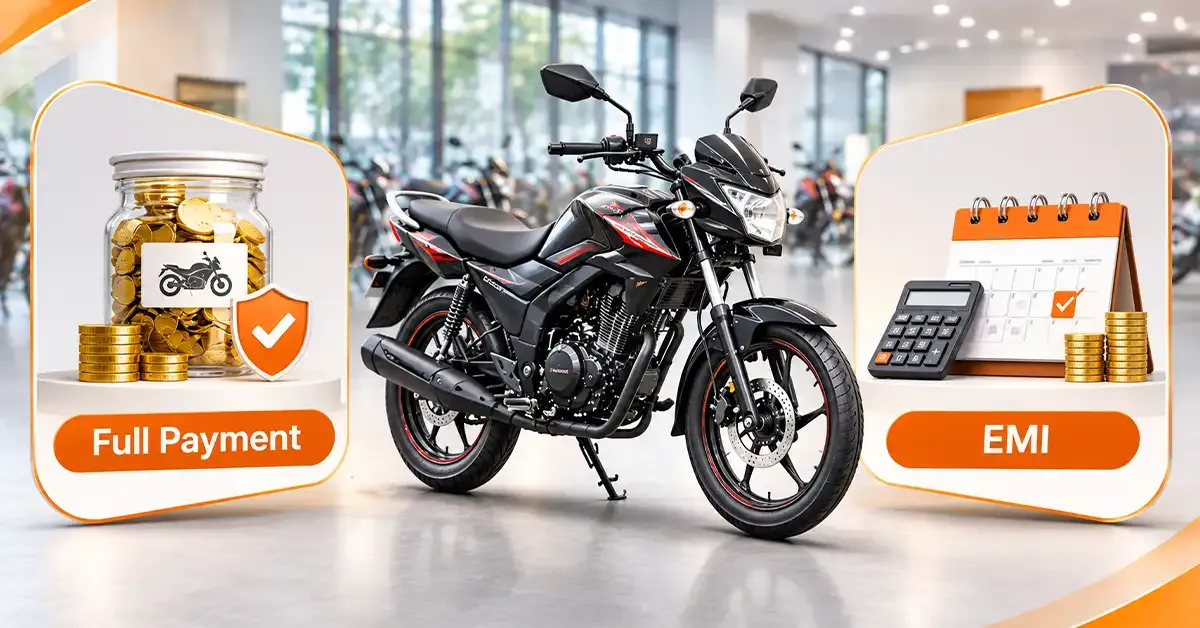
If you have enough savings, full payment usually makes more financial sense. No interest. And your future income stays free of loan repayments.
But emptying your savings for a bike is risky. A medical bill, a household repair or a job change can demand cash fast. Keep an emergency fund before you go the full payment route. Also set money aside for insurance renewals, fuel, servicing and replacement parts.
EMI suits buyers who need a motorcycle but want to hold on to their savings. It also lets salaried employees spread a big purchase over manageable monthly payments. Still, the instalment has to fit your household budget comfortably. Count rent, groceries, utility bills and any other loan repayments.
Here’s how the two compare:
| Factor | Full Payment | EMI Financing |
| Interest cost | None | Applicable |
| Monthly obligation | No loan EMI | Fixed repayment |
| Initial expense | Higher | Lower |
| Savings available | Reduced | Better preserved |
| Processing fees | Not applicable | May apply |
| Financial flexibility | Depends on remaining savings | Depends on EMI commitment |
Who should consider full payment?
- Buyers with enough savings after setting aside an emergency fund.
- People who want to avoid interest and processing charges.
- Buyers with stable finances and no need to hold back extra cash.
Who should consider EMI financing?
- First time buyers with limited savings.
- Salaried employees who like predictable monthly payments.
- Buyers who can comfortably afford the EMI and associated charges.
There’s a middle option too. Make a bigger down payment and finance only the rest. You borrow less, so you pay less interest. But don’t drain your savings just to shrink the loan.
What Should Buyers Check Before Booking a Bike?
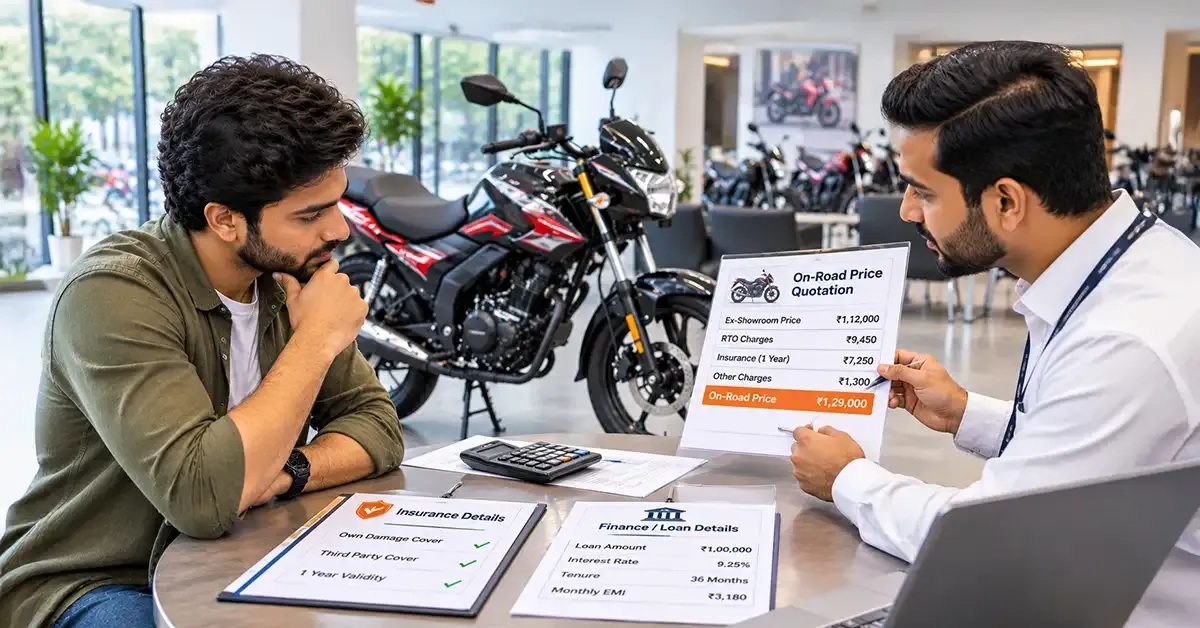
Before you pay the booking amount, collect quotes from several dealerships and finance providers. Festive discounts look good. The final payable amount is what counts.
Keep these points in mind:
- Compare on road prices: Ask for a full quotation covering insurance, registration and accessories.
- Check the interest rate: Compare offers from banks and authorised finance partners.
- Calculate the total repayment: Add the down payment, all EMIs and applicable charges.
- Review the loan agreement: Understand late payment penalties and prepayment conditions.
- Consider running costs: Keep money aside for fuel, servicing, insurance and repairs.
Check whether a dealer’s zero down payment offer carries extra charges. Low upfront doesn’t mean cheap financing. I’d walk away from any offer the dealer won’t put in writing.
Conclusion: Which Payment Method Makes More Sense?
Full payment is usually cheaper, since you skip interest and loan charges. But it only works if you still have decent savings left afterwards.
EMI gives you flexibility. It also raises the total cost of owning the bike. For most buyers, the smarter call is the method that protects your savings without creating a monthly burden you’ll resent.
FAQs About Bike Buying Options
- Is it better to buy a bike on EMI or make full payment?
Full payment is generally cheaper because it avoids loan interest and processing fees. However, EMI financing may be better for buyers who want to preserve their savings and can comfortably manage monthly installments.
- How much EMI will I pay for a Rs 1 lakh bike loan?
For a Rs 1 lakh loan at 12% annual interest, the EMI is approximately Rs 8,885 for 12 months, Rs 4,707 for 24 months, Rs 3,321 for 36 months and Rs 2,633 for 48 months.
- What is the ideal repayment tenure for a two-wheeler loan?
The ideal tenure depends on your monthly income and repayment capacity. A shorter tenure reduces the total interest paid but increases the monthly EMI. A longer tenure lowers the EMI but increases the overall borrowing cost.
- What charges should I check before taking a bike loan?
Buyers should check processing fees, applicable GST, documentation charges, administrative fees, foreclosure charges and late payment penalties. They should also review the Key Facts Statement (KFS) and compare the Annual Percentage Rate (APR).
- Can I finance the entire on road price of a bike?
It depends on the lender's loan-to-value limit and eligibility conditions. For example, SBI's two-wheeler loan scheme allows eligible customers to finance up to 85% of the vehicle's on-road price. The remaining amount must be paid by the buyer.
Also Read | Car Like Features on a Bike? Hero Xpulse 450 Gets Android Auto and Apple CarPlay


Previous
Next


Top News


Hero Splendor Plus On Road Price in India
More news from Hero



Best Bikes from Hero Brand

Hero Splendor Plus
 97.2 CC
 70 KMPL

Hero Xtreme 125R
124.7 CC66 KMPL
Hero Splendor Plus Xtec
97.2 CC70 KMPL
Hero Xtreme 160R
163.2 CC46 KMPL
Hero HF Deluxe
97.2 CC70 KMPL
Hero Glamour X 125
124.7 CC65 KMPLLatest Hero Models
Hero Xtreme 125R
124.7 CC66 KMPL
Hero Xtreme 160R 4V
163.2 CC48 KMPL
Hero Xtreme 250R
249.03 CC37 KMPLHero Glamour X 125
124.7 CC65 KMPL
Hero Splendor Plus Flex Fuel
97.2 CC62 KMPL
Hero HF Deluxe Flex Fuel
97.2 CC65 KMPLUpcoming Bike Models
 Launching Soon

Hero Karizma 400
223 CC30 KMPLLaunching Soon
Hero Xpulse 421
450 CCN/A Launching Soon
Hero Xpulse 160
163.2 CC40 KMPLLaunching Soon
Hero Scrambler 440
440 CC28 KMPLLaunching Soon
Hero Xtreme 400S
N/AN/A 


A-23, 3rd floor, A Block, Sector 9,Noida, Uttar Pradesh 201301
 support@thebikejunction.com
 +91-9773363849